
Industrial Extruder for Large-Diameter PE Infrastructure Pipe: How High-Output Production Serves Projects
Large-diameter polyethylene pipes, typically ranging from 400 mm to 1200 mm in outside diameter, play an important role in water distribution, gas transmission, and other major infrastructure systems. Supplying kilometres of pipe to a construction project creates a production challenge that extends beyond running equipment at high speed: output must remain stable while dimensions, material properties, and delivery schedules stay within specification. An industrial extruder must operate as part of a coordinated manufacturing system, where melt quality, cooling capacity, and downstream handling all influence the amount of acceptable pipe produced per shift.
Balancing Output Rates With Melt Stability
Large-diameter PE pipe requires substantial material throughput, particularly when thick walls and long production runs are involved. Raising screw speed may increase output, but the benefit depends on whether the drive system, screw geometry, and thermal controls can handle the additional load. Excessive shear or unstable melt pressure can disrupt flow through the die, while insufficient processing capacity may limit output even when downstream equipment has spare capacity. Manufacturers should assess sustained production performance rather than judge a line by its maximum rated speed alone.
Material behavior adds another layer of complexity. Polyethylene grades differ in melt flow characteristics, molecular structure, and processing requirements, all of which affect pressure, temperature, and melt strength. A stable process must deliver a uniform melt to the die without creating unnecessary thermal stress. Consistent feeding and controlled operating conditions become particularly important when large volumes of resin pass through the line over an extended shift.
The relationship between the extruder and the rest of the line determines practical throughput. An extrusion pipe machine needs a die designed for the target diameter and wall thickness, along with calibration and cooling systems capable of handling the pipe’s size and thermal load. If cooling becomes the bottleneck, increasing extrusion output may simply create dimensional instability or longer downstream queues. Capacity planning should account for the performance of the entire line, not just the extruder barrel.
Maintaining Dimensional Accuracy Across Long Runs
Dimensional control becomes more demanding as pipe diameter and wall thickness increase. Uneven melt distribution around the die circumference can create variations in wall thickness, while inconsistent cooling may contribute to ovality or residual stress. These issues can become costly over multi-kilometre orders because defects discovered late in production may affect significant lengths of pipe. Regular measurement and trend analysis help operators identify deviations before they develop into a larger batch problem.
Die design, calibration conditions, haul-off speed, and cooling-water temperature all influence the finished dimensions. Their settings must work together rather than be optimized independently. For example, changing line speed without adjusting cooling conditions may affect the pipe’s thermal profile, while inconsistent haul-off tension can interfere with stable dimensional control. Process records help production teams understand how adjustments influence the final product and reproduce successful settings across shifts.
Quality assurance should include both in-process monitoring and scheduled product testing. Outside diameter, wall thickness, ovality, and visual condition provide useful information, while application-specific tests establish whether the pipe meets the relevant standard. Inspection frequency can be adapted to process risk and production stability, but it should not be reduced simply because the line has run well for several hours. A documented sampling plan helps maintain consistent quality throughout extended orders.
Planning Capacity for Multi-Kilometre Infrastructure Orders
Large infrastructure contracts often require manufacturers to coordinate resin procurement, production capacity, storage space, and transport well before the delivery date. A realistic schedule should include startup and stabilization time, product changes, routine maintenance, quality checks, and potential interruptions. Calculating output from nominal kilograms per hour alone can produce overly optimistic delivery estimates because not every production hour generates saleable pipe.
Material availability is particularly important for large-diameter products, which can consume substantial quantities of resin. Procurement teams need forecasts linked to pipe dimensions, wall thickness, density, and planned production volume. Buffer stock may protect against supply delays, but excessive inventory ties up capital and warehouse capacity. Close coordination between sales, purchasing, and production helps manufacturers respond to changes in project schedules without creating avoidable material shortages.
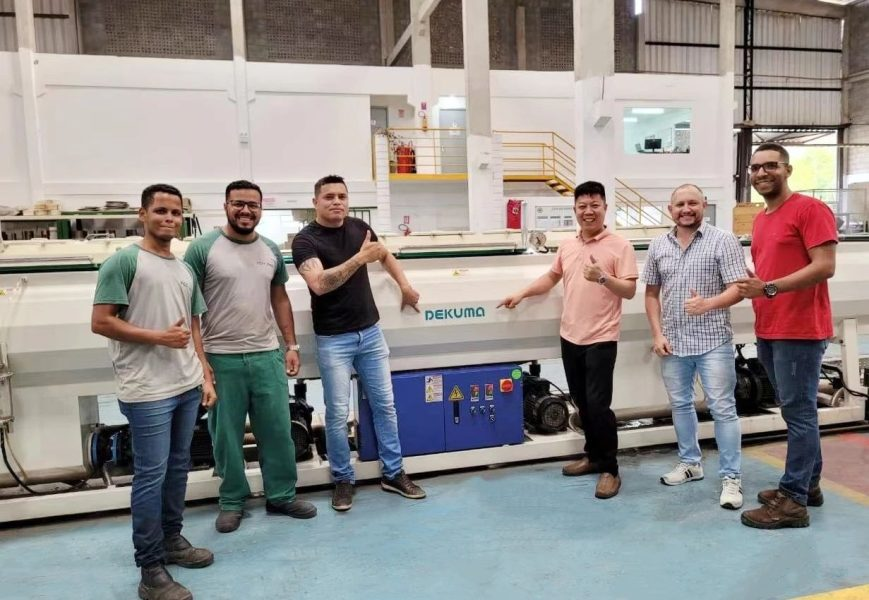
The production plan should also reflect the physical handling requirements of large pipes. Long lengths need adequate cooling space, lifting equipment, storage areas, and transport arrangements suited to their dimensions. If downstream handling cannot keep pace with extrusion, finished pipe may accumulate and interrupt production. DEKUMA reports that a South American pipe manufacturer has purchased its extrusion equipment covering the 20–1200 mm range since 2018, introducing dozens of production lines over six years. This case illustrates the scale of equipment deployment involved in serving broad pipe portfolios, although individual project requirements and actual output rates still need to be evaluated separately.
Conclusion
High-volume PE pipe manufacturing depends on more than the capacity to push large quantities of resin through a die. Stable melt behavior, consistent wall geometry, effective cooling, realistic production scheduling, and suitable downstream logistics all influence how reliably a manufacturer can supply infrastructure projects. When evaluating an industrial extruder, buyers should compare sustained output under representative conditions and examine how the complete line handles dimensional control during long production runs.
A suitable extrusion pipe machine must also match the target diameter range, material grade, and required quality standards. DEKUMA is one supplier that can be assessed against these technical and operational criteria, with production trials and project-specific capacity calculations providing a sound basis for investment decisions.