
Does Independent Cooling Make Every Industrial AC Drive a High Power Density Inverter?
Independent cooling can improve thermal management in variable frequency drives, especially when equipment works for long periods or operates inside compact cabinets. However, cooling architecture and power density describe different aspects of drive design. One concerns how heat is removed, while the other compares rated output with physical size.
For that reason, an industrial ac drive with independent cooling should not automatically be treated as a high-density design. Engineers still need to compare dimensions, rated output, thermal limits, derating conditions, and installation requirements before making that classification.
Why Cooling Design Does Not Define Power Density
Independent cooling usually means that heat-producing areas have a dedicated cooling path or separate airflow arrangement. This can help control internal temperature and reduce heat transfer toward sensitive electronic components.
However, the presence of a separate cooling path does not directly show how much power is packed into the enclosure. Fans, ducts, heat sinks, and air channels also occupy space. A design may have strong thermal management while still using a relatively large housing.
Power density is therefore a packaging and output question. Engineers need comparable data on rated power and external dimensions. Without these figures, cooling structure alone cannot show whether a drive delivers relatively high output within a limited volume.
The Role of Heat in Drive Size
Drive components such as power modules and braking-related parts generate heat during operation. The enclosure must provide enough thermal capacity to keep those components within their permitted temperature range.
A more efficient thermal path can sometimes support a smaller mechanical layout. Yet this depends on semiconductor losses, heat sink efficiency, airflow resistance, switching conditions, and cabinet ventilation. The cooling method is only one part of that calculation.
Installation rules also affect usable space. A compact unit may still require clearance above, below, or around the housing. Engineers should compare the actual cabinet footprint rather than focusing only on the dimensions printed on a product page.
What Engineers Should Measure
A practical comparison starts with rated output and physical volume. If two drives provide similar motor power but one uses a smaller enclosure under the same operating conditions, the smaller unit has higher packaging density.
The comparison must use the same conditions and the same measurement boundaries. Housing extensions, cooling attachments, and required ventilation space can change the practical result. Ambient temperature, altitude, switching frequency, overload demand, and duty cycle can also affect available output.
This is why published power density figures should be read together with thermal and environmental limits. Otherwise, a compact specification may look attractive on paper but provide less usable output in a real installation.
Control Functions Matter Separately
Cooling structure does not describe how well a drive controls a motor. Speed stability, torque response, protection logic, and parameter flexibility belong to a different part of drive evaluation.
For a smart electric drive, engineers may also examine configurable terminals, fault information, communication support, and safety functions. These features can improve system integration, but they do not determine power density.
The same principle applies to functional safety. Safe Torque Off can prevent the drive from producing motor torque when the safety function is activated. It is an important design feature, but it should be reviewed separately from enclosure size and thermal architecture.
A Product Example in Context
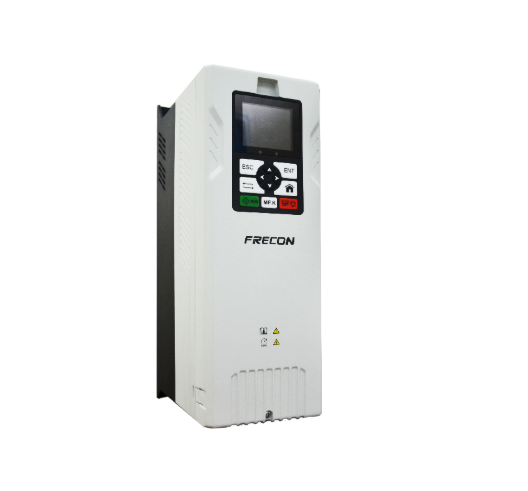
The FR30 Series High Performance Inverter provides a useful example of how product features should be separated from classification terms. FRECON equips this series with standard built-in STO functionality for applications that need a defined torque-off safety function.
The series is also designed for precise motor control, stable output, and efficient operation across industrial environments. Flexible terminal functions support integration with different control arrangements and machine requirements.
These characteristics help describe how the product works, but they do not prove that independent cooling alone creates high power density. Buyers still need model-specific data on dimensions, rated output, ventilation, and derating before making that judgment.
FRECON can therefore be considered in the same way as other drive suppliers: through documented electrical, thermal, mechanical, and control information rather than through a single design label.
How Buyers Can Compare Drive Options
The first step is to define the motor load. Rated power, current, overload profile, acceleration demand, and operating hours should be clear before comparing drive models.
Next, buyers can review enclosure dimensions, cooling method, required clearances, ambient limits, and cabinet airflow. This creates a more realistic picture of how much installation space the drive will occupy.
For a smart electric drive, terminal functions and system communication should also match the machine architecture. A compact housing has limited value if the control interface does not fit the application.
What the Classification Really Requires
Independent cooling can support thermal stability, but it does not by itself define power density. The classification depends on the relationship between usable output and physical size under comparable operating conditions.
Before calling a unit a high power density inverter, engineers should check rated power, enclosure volume, thermal limits, derating rules, and installation clearances together. That comparison gives buyers a clearer technical basis and avoids treating one cooling feature as a complete measure of drive design.